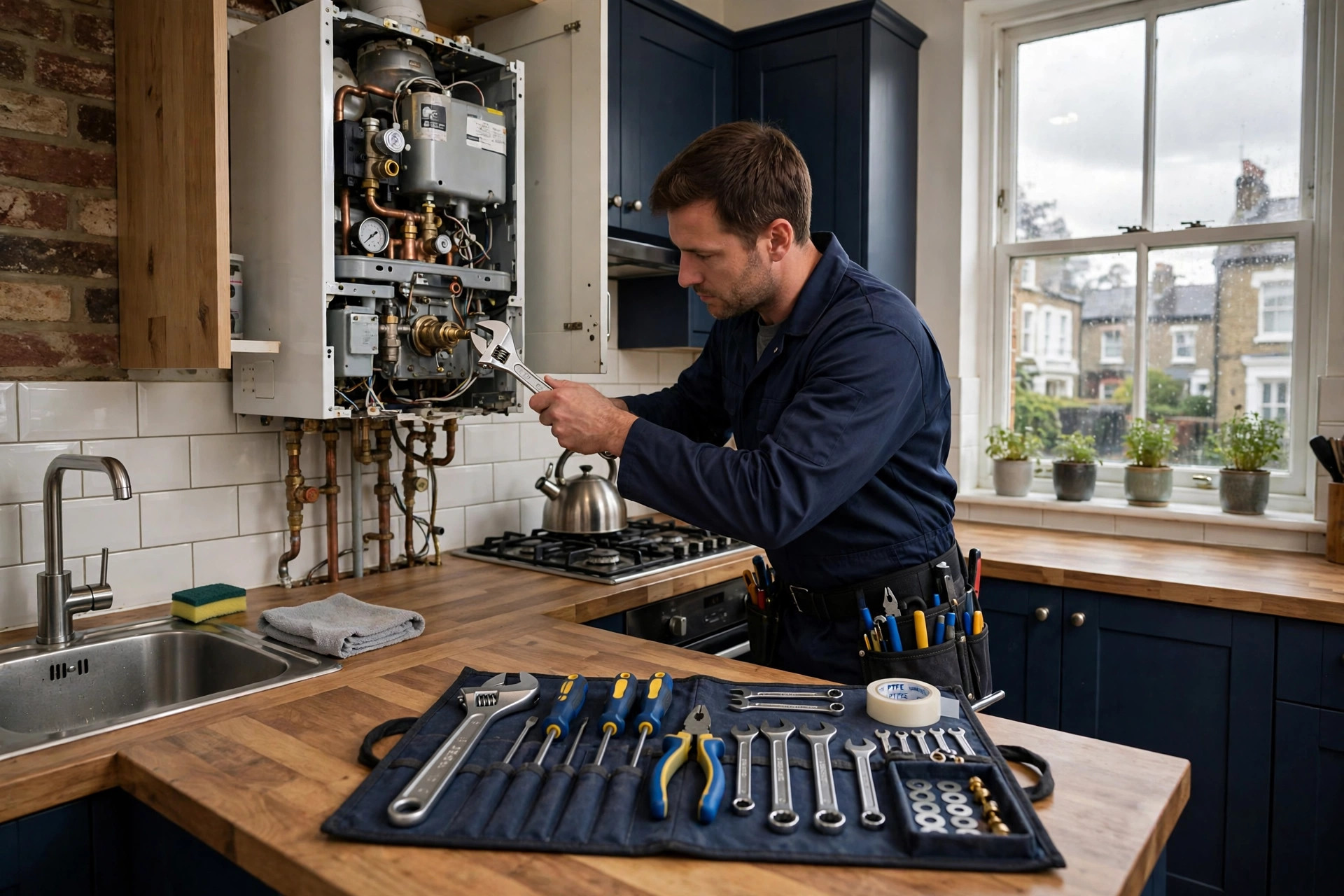
Quick answer: SEO for plumbers in London means showing up first when someone in your borough searches for help — "emergency plumber near me", "boiler repair Islington", or "bathroom fitter Croydon" — on Google Maps and in search results, with Gas Safe trust signals and reviews that turn that search into a call. It works through a complete Google Business Profile with honest service areas, separate pages for emergency, boiler, and bathroom work, borough pages for the areas you actually cover, and a steady stream of real customer reviews. SEORankGulf is an SEO service for businesses in Dubai and the Gulf that want more calls and customers from Google, and this guide applies the same local-search playbook to London plumbing, with the borough, trust, and pricing details that make it work in the UK capital.
It is 7 a.m. on a January morning in Hackney. A boiler has stopped, the house is cold, and the customer is not researching heating engineering. She types "emergency plumber near me" into her phone, looks at the top three map results, checks which one mentions Gas Safe and has recent reviews from people nearby, and calls. She does not scroll to page two. She does not open six websites and compare. The plumber who wins that call is the one Google already trusts for that exact search, in that exact borough, at that exact moment. That is the whole game for a London plumbing firm, and it is winnable — because most of your competitors are still relying on one generic "plumber London" page and hoping Google works out the rest.
This guide is written for the owner of that firm: the company with two to fifteen engineers, vans across two or three boroughs, and a phone that rings hardest for emergencies and boiler breakdowns. You will learn which searches actually bring plumbing jobs, how Google decides who shows up on the map in London, what pages your website needs, how Gas Safe and review trust actually work, and what a realistic first 90 days looks like. For the same playbook in a different city, our guide to SEO for plumbers in Dubai shows how the map-and-review pattern works for emergency trades generally — the London details below are what make it work here, not there. And if you want the price picture for a programme like this, our pricing page sets out our plans in full, matched to your business after a free audit, not before it.
Why London Plumbing Searches Are Not One Search
A London plumbing search is almost never a general enquiry. There are really four kinds of plumbing customer, and each one searches differently, expects a different answer, and is worth a different amount to you.
The first is the emergency customer. A burst pipe, a leak through a ceiling, a boiler that has died in winter. She searches "emergency plumber near me", "plumber near me", or "24 hour plumber" plus her area. She wants a phone number, a fast arrival time, and proof you cover her borough. She will call the first credible result. If your profile does not show your service areas, your hours, and recent reviews, you lose her in seconds — not because your engineers are worse, but because Google could not prove you were close and available.
The second is the boiler customer. He is not always in a panic, but he is close to spending real money. He searches "boiler repair", "boiler service near me", "new boiler installation", or "boiler breakdown" plus his borough. He compares two or three firms, reads reviews about boiler work specifically, and checks Gas Safe credentials before he calls. This customer is worth more than a single repair, because a boiler service done well becomes a service plan, and a service plan becomes a replacement boiler in a few years.
The third is the bathroom and renovation customer. She searches "bathroom fitter", "bathroom renovation", or "new bathroom installation" plus her area. She takes longer to decide, looks at photos, and wants to see finished work. She will not book from a map result alone. She needs a page with real project photos, a clear process, and a contact route that is not just a mobile number.
The fourth is the landlord, agent, and facilities customer: letting agents, landlords with portfolios, and building managers searching for "plumber for landlords", "property maintenance plumber London", or "commercial plumbing London". These jobs are steadier and larger, but the buyer reads properly. He wants a real company page, a clear commercial offer, and evidence you handle portfolios, not just one-off call-outs.
One website page cannot serve all four customers well. That is the first mistake most London plumbing firms make, and the first thing this guide fixes: you need separate pages, separate proof, and separate calls to action for each kind of job.
London Is Not One Market — It Is Thirty-Two Boroughs
This is the single most important London point, and the one most generic plumber SEO pages miss entirely. London is not one market with one ranking. It is thirty-two boroughs, plus the City, each with its own searches, its own competitors, and its own map results. Ranking for "plumber London" means very little if your vans cover Islington, Hackney, and Camden, because a customer in Croydon will see Croydon firms, and a customer in Ealing will see Ealing firms. Google shows map results by proximity and relevance, and no amount of city-wide content changes that.
So your strategy has to start with an honest map of where you actually work. List the boroughs and neighbourhoods your engineers genuinely cover within a realistic response time — not every borough in London, because claiming areas you cannot serve brings calls you cannot attend and reviews that complain about it. Then build the website around those areas: a borough page for each core area, genuinely written for that area, covering the housing stock there (Victorian terraces with old pipework in Islington, flats and mansion blocks in Kensington, new-build estates in parts of East London), the common jobs you see there, your response times, and recent review snippets from customers there.
A practical example makes this concrete. Take a five-engineer firm based in Islington, covering Islington, Hackney, Camden, and Haringey. Its best pages are emergency plumber Islington, boiler repair Hackney, and boiler service Camden — because those are the searches its customers actually make, in the places its vans actually go. A single "plumber London" page would compete with every firm in the capital for a phrase that brings it the wrong calls. Four honest borough pages compete with the firms in those boroughs, for the calls the firm can actually attend. That is not a smaller ambition. It is a smarter one.
The same logic applies to service areas on your Google Business Profile. List the boroughs and neighbourhoods you cover, accurately, and keep the list updated as your coverage changes. A profile claiming all of London looks impressive and performs badly, because Google cannot match it confidently to any one place. A profile claiming four boroughs, with pages to match, is a profile Google can actually show.
Google Maps Is Your Shopfront — Treat It That Way
For a London plumber, Google Maps is not a listing. It is the shopfront, the receptionist, and the review wall all at once. Most emergency customers never reach your website at all: they call straight from the map result. So the profile has to answer their questions before they tap.
Start with the basics, done properly. Your business name should be your real trading name, not a string of keywords. Your primary category should be plumber, with honest secondary categories for the work you actually do, such as boiler repair service, heating contractor, or bathroom remodeler, where those genuinely apply. Your service areas must list the boroughs you genuinely cover. Your hours must reflect reality, including whether you take emergency calls overnight and what "24 hour" actually means for you — a phone answered at 3 a.m., or a message taken until morning? Customers who discover the difference at 3 a.m. leave the review that warns the next customer.
Then add the details customers check in a crisis: a phone number that is answered, photos of real vans, real engineers in uniform, and real work — not stock images of smiling people holding wrenches. Add your services as individual entries — emergency call-outs, leak repair, boiler repair, boiler servicing, boiler installation, bathroom fitting, drain unblocking, landlord and property maintenance — each with a short, plain description. A profile with one vague service line looks like a company with one vague offer. A profile with named services looks like a company that has done this job before.
Reviews are where most plumbing firms either win or quietly lose. A customer who has just had a leak fixed will leave a review if you make it easy in the right moment: a text message on the way out, with a direct link, while the relief is fresh. Ask for the review about the specific job — "boiler fixed same day in Islington" — because future customers search for exactly those phrases, and reviews that mention the borough and the job are worth far more than "good service". Answer every review, including the bad ones, calmly and specifically. A firm with 200 reviews and no replies looks automated. A firm with 80 reviews and thoughtful replies looks human, and humans get the call.
One more map truth that London plumbers often miss: the map pack shows three businesses, and the order changes by borough. Ranking in Islington does not mean ranking in Croydon. That is why borough pages matter so much — they are how Google connects your business to each area you serve.
The Pages Your Website Actually Needs
Think of your website as a set of doors, one per customer. A single "plumber London" page is one door for four different customers, and most of them will walk past it. Here is the set that actually works for a London plumbing firm.
First, a service page for each real service: emergency plumbing, boiler repair, boiler servicing, boiler installation, bathroom fitting and renovation, drain unblocking, and landlord or property maintenance. Each page should say, in plain language, what the job includes, what it does not include, how long it usually takes, what areas you cover for it, and what to do right now — call — if the problem is urgent. A boiler servicing page that explains the visit step by step (safety checks, flue and pressure checks, controls check, report) will always beat a page that just says "we service boilers".
Second, a borough page for each area you serve properly. Not a copied paragraph with the borough name swapped — Google and customers both spot that instantly — but a genuinely useful page per borough: the housing types there, the common faults you see there, your response times, and recent review snippets from that borough. Eight honest borough pages beat thirty copied ones, and they are also how you show up in "plumber Islington" instead of only "plumber London".
Third, a small set of answer pages for the questions customers actually type: why the boiler pressure keeps dropping, what to do when a pipe bursts, whether a power flush is really needed, how often a boiler should be serviced, and what a landlord's gas safety check actually covers. These pages do two jobs at once: they bring in the boiler and maintenance customer who is not in a panic, and they prove to Google that your site knows this trade rather than just selling it. Keep them honest. A page that says a power flush fixes everything will bring you a call and a disappointed customer. A page that explains when it helps and when it does not will bring you a customer who trusts you before you arrive.
Fourth, a commercial and landlord page, if you do that work. Agents and landlords do not book from a residential page. They want to see portfolio experience, response agreements, gas safety certification handling, and a contact route that is not just a mobile number — an email, a form, and a named contact. If you do not do commercial work, say so clearly and point residential customers to the right page instead. Clarity saves everyone time, including you.
Want this for your business? SEORankGulf builds exactly this page set for trade companies — profile, service pages, borough pages, and reviews that bring calls. Get a free SEO audit on WhatsApp — an honest read on what your company needs, including telling you if you do not need us yet. Call now or message SEORankGulf on WhatsApp at +92 315 0642491 for a free SEO audit. We will look at your Google Business Profile, your service and borough pages, your website speed, your reviews, and your competitors, and give you a straight answer on what is holding calls back.
Gas Safe, Checkatrade, and Trust a Customer Can Check
In London plumbing, trust is not a soft idea. It is a set of things a customer can check before letting a stranger into their home, and your website has to make that checking easy.
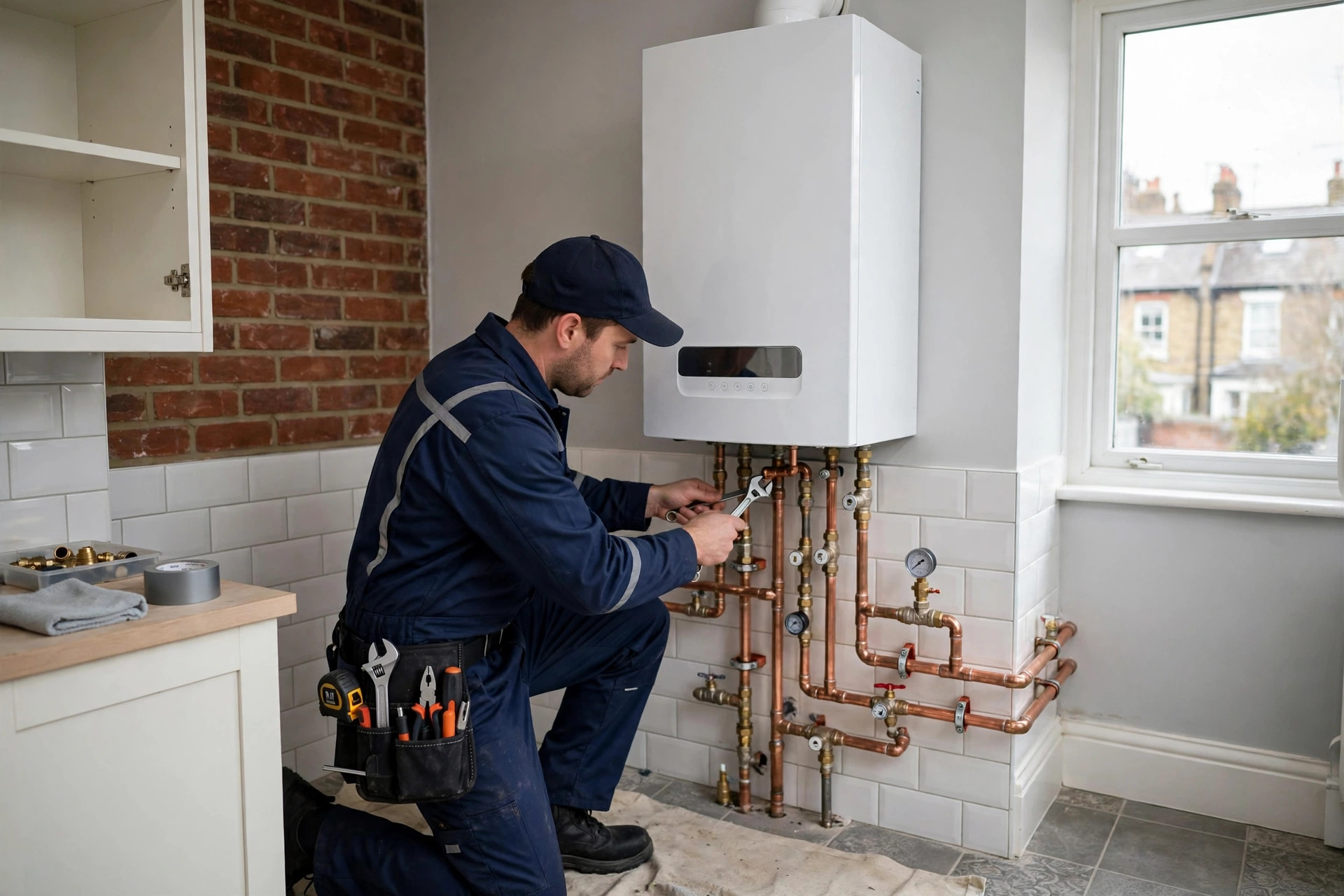
Gas Safe is the first and most important. In the UK, anyone working on gas appliances must be Gas Safe registered — it is a legal requirement, not a badge of honour. If you do gas work, say so clearly, show your registration, and link to the Gas Safe Register where a customer can verify you. A boiler page without a Gas Safe mention is a page that makes a careful customer call someone else. A boiler page with a clear, verifiable Gas Safe statement is a page that removes the customer's biggest worry before the phone call.
Checkatrade, Trustpilot, and Google reviews are the second layer. London customers check more than one source, especially for larger jobs like boiler replacement or bathroom renovation. Do not hide a weak profile on one platform behind a strong one on another. Build all of them honestly, with the same review system: a message after every job, with a direct link, while the job is fresh. And never buy reviews. Bought reviews are easy for platforms to spot, hard to recover from, and in a trade where trust is everything, they are the fastest way to lose it permanently.
Want this for your business?
SEORankGulf ranks your business on Google's first page — with local SEO, technical fixes, and content that brings customers.
Get a free SEO auditPhotos are the third layer, and they matter more for bathroom and boiler work than for emergency work. A bathroom page without finished-project photos will not convert a renovation customer, however good its text is. Show real projects, with the customer's permission, including the before state where it helps. A boiler page benefits from photos of tidy installations, labelled pipework, and engineers working cleanly in a customer's home — not stock images. Customers can tell the difference, and so can Google.
One published detail from our November 2026 research is worth noting honestly: one London plumber SEO agency's search snippet mentioned a £699 one-time fee for its service. That figure is reported here only as a snippet mention, not as verified pricing for the market, and it illustrates a wider point — London customers do look for price signals, but a single fee with no scope behind it tells them almost nothing. Your pages should give honest scope and ranges, not a single number designed to win a click.
What Customers Type, Word for Word
Good plumber keyword work is not about clever tools. It is about listening to how customers actually talk when something goes wrong. They do not search for "plumbing solutions". They search for the problem, the place, and the urgency, in that order.
Emergency and problem searches sound like this: "emergency plumber near me", "plumber near me", "burst pipe plumber", "leaking pipe repair", "blocked drain plumber". These are the highest-intent searches in the trade, and they belong on your emergency and service pages, in headings and in the first paragraph, in the customer's own words.
Boiler searches sound like this: "boiler repair near me", "boiler service", "boiler breakdown", "new boiler installation", "boiler engineer" plus a borough. These customers compare, so the pages need honest scope: what a service includes, what a repair usually involves, and what a replacement genuinely costs in broad terms, without pretending every boiler costs the same.
Borough searches sound like this: "plumber Islington", "emergency plumber Hackney", "boiler repair Camden", "bathroom fitter Croydon". Each one deserves its own borough page, as above, not a single page stuffed with every borough name in London.
Landlord and commercial searches sound like this: "plumber for landlords London", "property maintenance plumber", "commercial plumbing London", "gas safety certificate landlord". These belong on the commercial page, with language an agent recognises: response times, certification handling, portfolio reporting, and invoicing.
One warning about keywords: do not stuff them. A page that repeats "plumber London" twenty times reads like spam to customers and to Google, and it will not outrank a page that answers the question properly. Use the customer's phrase once in the heading, once early in the text, and then write naturally about the job. The pages that win in this trade are the ones a customer would actually want to read while waiting for an engineer.
Speed, Mobile, and Trust on the Phone
Almost every plumbing search happens on a phone, often with water on the floor, a cold house, and very little patience. If your website takes six seconds to load, shows a desktop layout squeezed onto a small screen, or hides the phone number behind three taps, you have lost the call before the customer reads a word.
Test your own site the way a customer experiences it: on a phone, on mobile data, in a hurry, with the question "can I call this firm in under ten seconds?" The number should be visible at the top of every page, tappable, and the same number as your Google profile. A form that asks for ten fields will be abandoned. A form that asks for name, borough, and problem, with a photo upload, will be used — and a photo of the leak, the boiler display, or the error code saves a phone call of its own.
Trust signals matter more in this trade than in most, because a stranger is coming into someone's home. Show real photos of engineers and vans, not stock images. Show Gas Safe registration where it applies, and say plainly which boroughs you cover and which you do not. Show recent reviews on the site itself, not just on Google. And never promise an arrival time you cannot keep: "same-day service in Islington and Hackney, usually within two to four hours" is a promise you can keep and a reason to call. "30 minutes anywhere in London" is a promise that creates angry reviews when traffic on the North Circular disagrees.
For a useful comparison of how other trades handle this — AC repair faces the same emergency-phone problem in a hotter climate — our guide to SEO for AC repair companies in Dubai shows the same map-and-review pattern working in a sister trade.
Reviews, Photos, and the Job After the Job
Reviews are not a one-off task. They are a system, and in the plumbing trade the system is simple: every completed job is a chance to earn one, and the best moment is immediately after the job, while the customer is relieved and the heating is back on.
Build it into the visit. The engineer finishes, explains what was done in plain language, leaves the area clean, and sends a short text message with a direct review link before leaving the property. No long email three days later. No generic "please review us". One message, one link, one sentence about the job: "Thanks for having us fix the boiler in your Islington flat today — a quick review here helps other residents find us." Firms that do this consistently collect reviews every week. Firms that leave it to chance collect them every few months, and then wonder why a competitor with fresher reviews outranks them.
Photos work the same way. With the customer's permission, a before-and-after photo of a repaired leak, a tidy boiler installation, or a finished bathroom is worth more than any stock image. It proves you were there, it proves the work, and it gives future customers something real to look at. Upload real job photos to your Google profile regularly, with honest captions naming the job and the borough, not keyword-stuffed captions.
And handle the bad review properly when it comes, because in a trade with emergency call-outs, it will. Reply quickly, calmly, and specifically: acknowledge the problem, say what you will do about it, and move the conversation to a phone call. Future customers read your reply more than they read the complaint. A defensive reply loses two customers: the complainer and the reader. A human reply often wins the reader.

A Realistic First 90 Days
Anyone who promises first-page London plumbing rankings in two weeks is selling you something that will not survive contact with reality. Here is what a realistic first 90 days looks like for a London plumbing firm starting from a weak online presence.
Days 1 to 30 are foundations. Fix the Google Business Profile properly: categories, service areas, services, hours, photos, and a review link ready to send. Fix the website's speed and mobile layout, make the phone number tappable everywhere, and publish or rewrite the core service pages: emergency plumbing, boiler repair, boiler servicing, and drain unblocking. Start the review system on every job from day one, because reviews earned in month one are still helping in month six.
Days 31 to 60 are borough and answer pages. Publish the first five to eight borough pages for the areas you actually serve best, each one genuinely written for that borough. Publish the first answer pages: the dropping boiler pressure problem, what to do when a pipe bursts, how often a boiler should be serviced, and what a landlord gas safety check covers. Start a simple monthly check: which searches brought calls, which pages brought messages, and which boroughs are still quiet.
Days 61 to 90 are commercial and depth work. Publish the landlord and commercial page if you do that work, refresh the boiler servicing pages ahead of winter, and build the service-plan offer page for boiler customers. By now you should be seeing movement: more map calls from your core boroughs, more messages with photos, and a review profile that looks alive. Full first-page dominance across every borough takes longer — typically three to six months for a competitive London trade — but the calls usually start well before the rankings finish, because map visibility and reviews move faster than website rankings.
What should you measure? Not just rankings. Count phone calls from Google, count messages that started from a search, count direction requests on your profile, and count how many of those became booked jobs. A report that shows "you rank #4 for plumber London" but cannot say how many calls that produced is a report about Google, not about your business. A report that shows calls, messages, and bookings by borough is a report about your diary, and that is the only one worth paying for.
The Mistakes That Quietly Cost London Plumbers Calls
A few mistakes come up again and again in this trade, and they are all avoidable.
The first is the copied borough page. Thirty pages with the same paragraph and a swapped borough name do not rank, and when a customer does land on one, the emptiness is obvious. Write fewer, better borough pages.
The second is the fake review shortcut. Bought reviews, reviews from staff, and reviews for jobs that never happened are easy for platforms to spot and hard to recover from. One honest review a week beats fifty fake ones that vanish in a cleanup.
The third is the invisible phone number. A beautiful website with a contact form and no tappable number is a website built for a desktop world that plumbing customers do not live in.
The fourth is the price lie. A page that promises a boiler repair "from £29" and then charges £300 on site will generate calls and destroy trust in the same week. Honest ranges — "most boiler repairs in our experience fall between X and Y, depending on the part" — bring fewer but far better customers, and far fewer angry reviews.
The fifth is the winter unpreparedness. Firms that enter winter without serviced boiler pages, without a review system, and without borough pages start every cold snap from zero. The quiet months are when the next winter is won.
Frequently Asked Questions
How long does SEO take to bring plumbing calls in London?
Map and review work can bring extra calls within the first month, because a complete profile and fresh reviews change what a searcher sees immediately. Website rankings for competitive phrases like "plumber London" usually take three to six months of steady work. Anyone promising first-page results in two weeks should be asked exactly how they plan to do it, in writing.
Should a London plumber target "plumber London" or borough searches first?
Borough searches first, almost always. "Emergency plumber Islington" or "boiler repair Hackney" are less competitive, closer to where your engineers actually go, and far more likely to turn into a call than the city-wide phrase. Win your core boroughs, then expand the map outward.
Do reviews really affect plumbing rankings, or just trust?
Both. Fresh, detailed reviews help a profile show up more often in map results, and they are also the first thing a worried customer reads before calling. A profile with recent reviews mentioning the borough and the job beats a profile with older, vaguer reviews, even if the older profile has more of them.
Is Gas Safe registration really a ranking factor?
Gas Safe registration itself is a legal requirement for gas work, not a Google ranking trick — but showing it clearly, verifiably, on your boiler pages and profile removes the customer's biggest worry and turns more searches into calls. Trust converts, and conversion is what rankings are for.
What is the single most useful first step for a London plumbing firm?
Fix the Google Business Profile and start the review system on every job this week. It costs nothing, it changes what emergency searchers see within days, and every other piece of SEO work builds on it. A website without a working profile is a shop with no sign.
Does a London plumber need separate pages for boiler work?
Yes. Boiler customers search differently, spend more, and check credentials more carefully than emergency customers. A dedicated boiler repair, servicing, and installation set — with Gas Safe proof, honest scope, and real photos — converts far better than a single general plumbing page trying to do every job at once.
Your Next Step
If you run a plumbing firm in London, start with the profile and the review system this week, then build the service and borough pages one borough at a time. The firms that win the winter are the ones that did the work in the months before it. And if you want an honest outside view of where you stand — profile, pages, speed, reviews, and competitors, in plain language — that is exactly what our free audit does. Get a free SEO audit on WhatsApp today. Call now or message SEORankGulf on WhatsApp at +92 315 0642491. We will tell you which pages to build first and why — or tell you honestly if you do not need us yet. Our plans are set out in full on our pricing page, matched to your business after the audit, not before it. Your closing next step: book the free SEO audit, and read our guide to SEO for plumbers in Dubai to see the same emergency-trade playbook in another city before you speak to any provider.