Quick answer: SEO for Dubai hotels means winning two searches: travellers looking for a hotel like yours, and guests searching your hotel's own name — then booking direct instead of through an OTA. It takes strong room, venue and neighbourhood pages, reviews, and Arabic content. Expect early gains in three to four months.
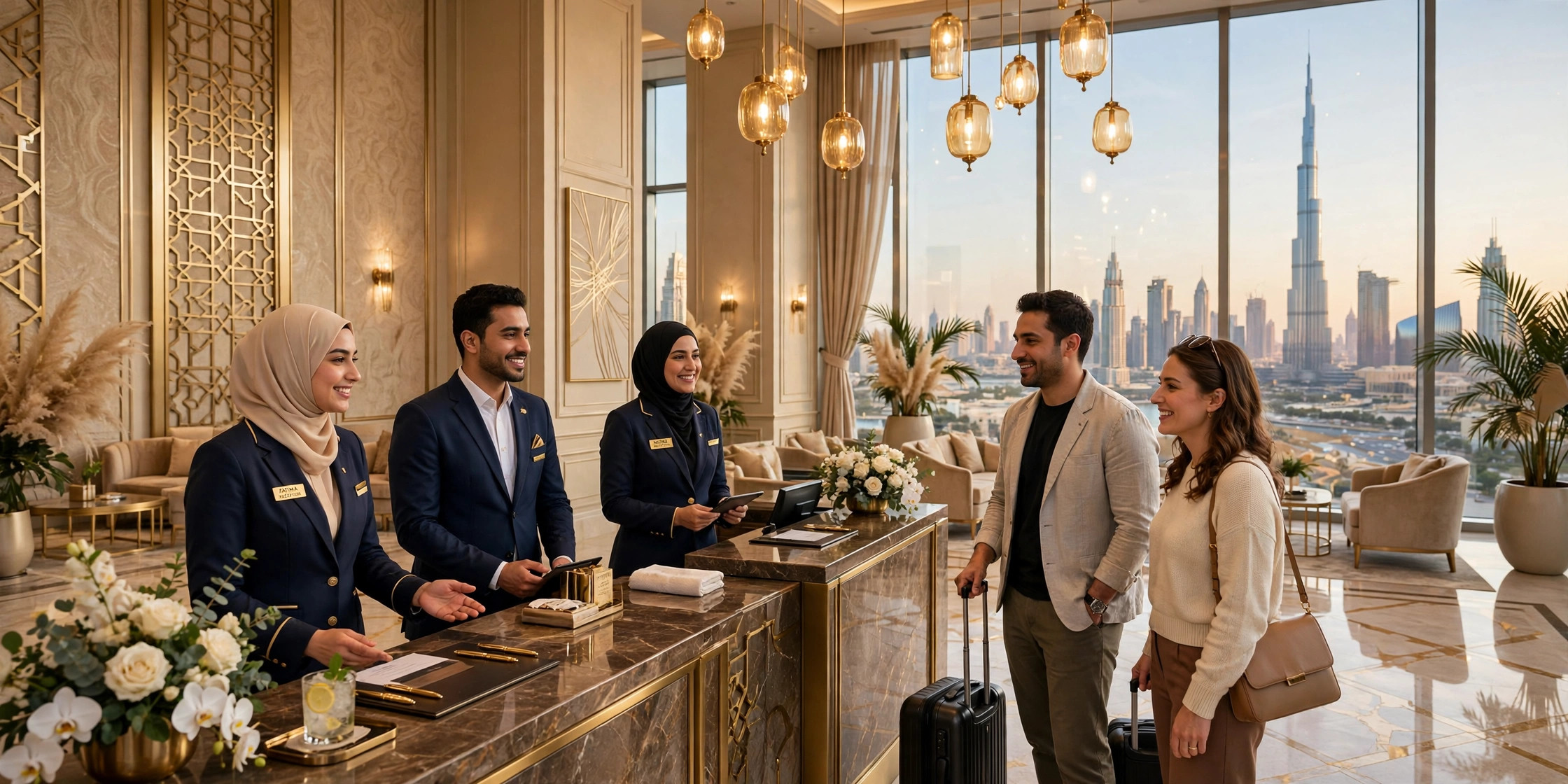
Picture a couple in London planning their first Dubai trip. They have seen your hotel on a booking platform, liked the photos, and now — the way smart travellers do — they search your hotel's name on Google to check the price on your own site before they book.
What they find decides your margin. If your website appears first, loads fast and offers a clear best-rate reason to book direct, you keep the full room revenue. If an OTA's page for *your own hotel* outranks you — with its own link, its own loyalty pitch — they book there, and a commission commonly published at 15 to 25 percent of the booking leaves your business on a guest who was already looking for you by name.
That moment, repeated hundreds of times a month, is what hotel SEO in Dubai is really about. Not vanity rankings. Direct bookings, owned.
This guide lays out the system: the pages to build, the searches to win, the rules to respect, and what honest hotel SEO costs. It follows the same local-first logic as our guide to local SEO for restaurants in Abu Dhabi — hospitality businesses live on maps, reviews and neighbourhood searches — tuned here for hotels, where the prize is bigger.
The Real Competition Is Not the Hotel Next Door
Most Dubai hotels obsess over the property across the road. For search, the harder competitor is the OTA shelf. Booking platforms spend heavily to appear for your name, your neighbourhood and your category: "hotels near dubai mall", "5 star hotel palm jumeirah", even "[your hotel name] reviews".
You will not outspend them, and you do not need to. You need to own three things they cannot copy:
- Your branded search. When a guest types your hotel's name, your site should own the first screen: the top result, the knowledge panel, the map listing, your direct-booking offer. This is winnable, and it is where commission quietly leaks today.
- Your specific assets. Your wedding lawn's capacity, your rooftop's view, your spa's signature treatment, your distance in minutes from the Mall or the Marina. OTAs list you generically. Your pages can be exact.
- Your guest trust. Fresh reviews answered well, real photography, accurate facilities and policies. Travellers cross-check you on Google before they trust a rate.
A good hotel SEO plan starts with an audit of exactly these three: branded search, asset pages, trust signals — before a single new page is written. That audit is what our SEO audit service covers for hospitality clients, and it is free to start.
The Pages That Win Bookings
Hotel websites often have one long "Rooms" page and a PDF menu. Google cannot rank what does not exist as its own page. The structure that wins direct bookings looks like this:
- Room-type pages. One per category — deluxe king, family suite, club room — with real sizes, occupancy, views and amenities. These pages catch "family suite dubai marina" style searches OTAs flatten into filters.
- Venue pages. Weddings, banquets, conferences, MICE. A dedicated page per venue with capacity, layouts and photo galleries wins high-value enquiries that never touch OTAs at all.
- Event and season pages. New Year's Eve, Dubai Shopping Festival, Ramadan stays, summer family offers. Built weeks ahead, these catch planning searches at their peak.
- Neighbourhood and guide content. "Things to do near [your area]", "best time to visit Dubai", "business travel guide to DIFC". These catch travellers at the dreaming stage — and your hotel becomes the familiar name when they book.
- Dining and spa pages. Your restaurants, afternoon tea and spa, each with its own page, menu and reservation path. They rank for non-guest searches too — and residents who dine with you become guests who stay with you.
Each page needs the basics executed well: fast mobile load, honest photos, schema markup for the hotel and its offers, and a booking path with no dead ends. Our broader SEO services plans build this structure as the first quarter's work for hotel clients.
Branded Search: Stop Paying Commission on Your Own Name
Run this test today: search your hotel's exact name. Then your name plus "reviews", plus "booking", plus "restaurant". Count how many first-screen results are yours.
Every OTA result sitting above your own website in those searches costs you money twice — once in commission, once in the guest relationship you never start. The fixes are practical:
- Your homepage title and content must carry your exact name, area and category cleanly
- Your Google Business Profile must be claimed, complete and matched to your licensed name
- Review profiles must be answered and current; guests comparing you to an OTA's review score should find the fuller picture on Google
- Your best-rate promise and direct-booking benefits (flexible cancellation, welcome perks, late checkout where you offer them) must be visible on the pages guests land on
- Structured data should tell Google your name, address, star rating range and check-in facts without error
None of this is exotic. It is housekeeping with a revenue line attached, and it is usually the fastest-paying work in a hotel SEO programme.
One more channel belongs in this section: Google's own hotel results. When travellers search a hotel name or a destination, Google shows a hotel block with prices from OTAs — and, where a hotel provides its rates properly, from the hotel's own booking engine. Appearing there with a competitive direct rate is not advertising trickery; it is the product of correct structured data, an accurate profile and a booking engine that feeds Google cleanly. Hotels that skip this setup hand that shelf entirely to intermediaries. A proper hotel SEO audit checks whether your direct rates surface in Google's hotel results, and fixes the feed and data issues if they do not.
Reviews, Maps and the Guest's Three Checks
Travellers check three things before booking a Dubai hotel: where it sits on the map, what recent guests say, and whether the photos are real. Your SEO must serve all three.
Your map listing needs accurate location (a wrong pin on the Palm or in Deira is revenue lost daily), current photos, correct amenities and a questions section that is actually answered. Reviews need a system: a polite post-stay request, replies to every review in the guest's language where possible, and a service-recovery habit for the unfair ones — future guests judge your replies more than the complaint. Photos need to be yours and recent; travellers can spot stock imagery instantly, and so can Google's quality signals.
Want this for your business?
SEORankGulf ranks your business on Google's first page — with local SEO, technical fixes, and content that brings customers.
Get a free SEO auditDubai adds one more layer: your guests search in Arabic, English and Russian above all. Reviews answered across languages, and core pages in Arabic at minimum, signal a hotel that expects its actual guest mix — and they rank for searches your English-only rivals miss.
Do not neglect your profile's question-and-answer section either. Guests ask practical things before they book: Is parking free? What time is breakfast? How far is the airport shuttle? Each unanswered question is a small leak toward a competitor whose answers are one tap away — or toward an OTA, whose pages answer everything except why booking direct is better. Assign the section an owner, answer within a day, and seed it honestly with the questions your front desk genuinely hears. Small details, faithfully kept, are what five-star search presence is actually made of.
Dubai Details That Generic SEO Misses
- Licensing and classification. Your listings, star claims and offers must match your Dubai Department of Economy and Tourism (DET) licensing. SEO that publishes an unlicensed claim or a stale offer is a liability, not an asset.
- Seasonality is extreme. Peak winter demand, Shopping Festival, Ramadan and the summer trough each need pages prepared *before* the search wave, not during it. A content calendar built on Dubai's year is a competitive weapon.
- Events drive windfalls. Concerts, exhibitions at World Trade Centre, GITEX, Art Dubai — venue-adjacent and date-specific searches spike hard. Hotels with standing event pages catch bookings rivals scramble for.
- Source markets search differently. Guests from Saudi, India, the UK, Russia and Germany plan differently and search in different languages and engines. Your content priorities should follow your actual guest mix, which your PMS already knows.
- The staycation market is real. UAE residents book short breaks inside the country all year — a Friday brunch-and-stay, a Palm weekend, a festival escape. Resident-focused pages and offers, written for people who already know Dubai, catch a segment that international hotel marketing routinely ignores, and those guests book direct at far higher rates because they already trust the brand they are searching.
What Hotel SEO Costs in Dubai
Hotel SEO is priced against the value of direct bookings, and ranges reflect scope. In line with the market bands in our SEO services cost in Dubai guide:
- Foundation (branded search repair, profile, core room pages): from about AED 1,100 a month at our entry plan — SEORankGulf plans run at US$300, US$600 and US$1,200 a month, month to month
- Growth (full page system — rooms, venues, dining, guides — plus Arabic core pages): roughly AED 2,200 to 4,400 a month across the market
- Full programme (multi-property, multilingual, events calendar, digital PR): AED 4,400 a month and above
Judge any quote against one number: a small shift of bookings from OTA to direct recovers commission on every shifted room night. A modest monthly programme that moves even a thin slice of your OTA volume to direct pays for itself — and unlike an ad campaign, the pages and rankings stay yours when you stop. Be wary of quotes far below these bands promising the full system: venue pages, multilingual content and review programmes are skilled hours, and the maths of very cheap full-service hotel SEO does not survive a calculator.
Red Flags for Hotels
- Guaranteed rankings or guaranteed booking numbers. Google decides rankings; guests decide bookings. Honest providers promise the work and report the trend.
- Review manipulation. Bought reviews, staff reviews, review gating tricks. Platforms remove them, and a flagged profile in high season is a disaster no contract compensates.
- Fake "official site" tactics or brand bidding tricks against your own name. Anything that risks your accounts or your OTA relationships for a short-term spike.
- No mention of DET licensing, seasons or source markets. A provider who talks about Dubai hotels without these does not know this market.
- Lock-in first, audit later. Twelve-month contracts signed before your branded search has even been examined.
A Realistic Timeline
Month 1: Branded-search and profile audit, fixes begin, page system designed around your rooms, venues and calendar.
Months 2 to 3: Room-type and venue pages live; review system running; neighbourhood and dining pages climb. Direct-booking share begins to move where branded fixes bite.
Months 4 to 6: Event and guide content compounds; Arabic core pages live; measurable growth in direct organic bookings in your analytics, reported against OTA volume.
Months 6 to 12: The library effect. Your hotel becomes the answer for its area's searches — weddings, stays, dining, events — and the direct channel grows into an asset your revenue team plans around.
Peak-season results depend on starting before the wave. A programme begun in the summer trough is positioned for the winter peak. One begun in December is building for next year — worth doing, but know which year you are buying.
Questions to Ask Before You Sign
- What does our branded search look like today, and what will you fix first?
- Which pages will you build in quarter one — rooms, venues, events — and in what order?
- How will you handle Arabic (and Russian, if our mix needs it) content?
- How will reviews be requested and answered, within platform rules?
- What will you report: rankings, or direct bookings against OTA share?
- Is everything month to month, and do we own the content and profiles?
Getting Started
Begin with the branded-search test and an honest audit. Search your own name the way a guest in London, Riyadh or Moscow would. Then let us do it properly: profile, pages, rivals and OTA leakage, in a plain-English report with a page-by-page plan.
The audit is free. Message us on WhatsApp at +92 315 0642491 or start on our SEO audit page. If the plan fits, our plans start at US$300 a month with no lock-in — and if your in-house team would rather run it, the audit still gives them the map.
Frequently Asked Questions
How does SEO increase direct bookings for a Dubai hotel?
It wins the searches travellers make before booking: your hotel's name, your area and category, your rooms, venues and dining. When your own pages own those results — with your best-rate reasons to book direct — guests book on your site instead of through an OTA, and you keep the commission, commonly published at 15 to 25 percent on OTA bookings.
How long does hotel SEO take to show results?
Branded-search and profile fixes can move direct bookings within the first one to two months. Room, venue and guide pages build over months two to six. Event and seasonal pages must be published ahead of their demand wave. Full compounding — a direct channel that rivals your OTA volume in strength — is a six to twelve month build.
Do Dubai hotels need Arabic content?
For most, yes — at least for core pages. Arabic is a primary search language for regional guests, and Arabic pages face far less competition than English ones. Hotels with significant Russian-speaking guests should weigh Russian core pages too. Start with your homepage, top room types and booking information, and expand by guest mix.
What does hotel SEO cost in Dubai?
Foundation work starts from about AED 1,100 a month at our entry plan (US$300); full growth programmes across the market run AED 2,200 to 4,400 and above. SEORankGulf plans are US$300, US$600 and US$1,200 a month, month to month. Judge cost against commission saved: shifting even a small share of OTA bookings to direct can fund the whole programme.
Can SEO reduce our dependence on OTAs?
Yes — gradually, and without burning the OTA channel, which still brings discovery. SEO grows the direct channel: branded search, repeat guests, venue and event enquiries that OTAs never carried. The goal is a healthier mix where OTAs introduce guests and your own site keeps them, not the end of OTA listings.
Get a Free SEO Audit for Your Hotel
Search your hotel's name and see who owns the first screen. Our free audit maps your branded search, your profile, your page gaps and your OTA leakage, then lays out a direct-booking plan in plain English. SEORankGulf plans run at US$300, US$600 and US$1,200 a month, month to month, with all content yours. Message us on WhatsApp at +92 315 0642491 or start at our SEO audit page. No booking guarantees — just careful work, reported against the number that matters: direct revenue.