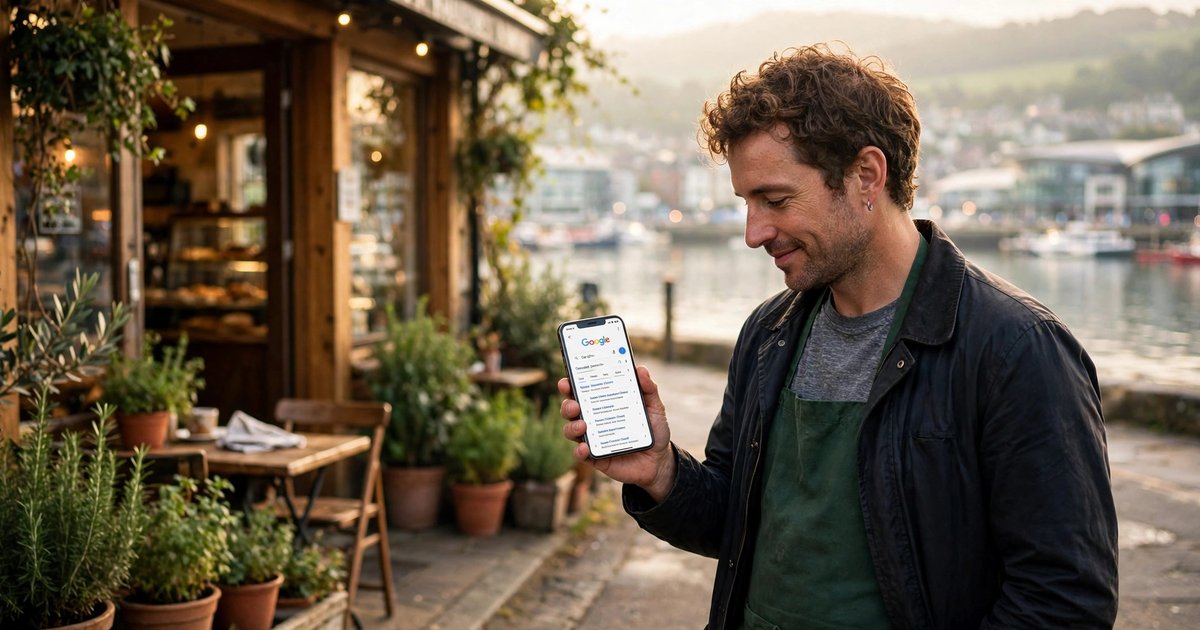
SEO in Wales means making your business easy to find when people in Cardiff, Swansea, Newport or Bridgend search on Google. It covers your website, your Google Business Profile, your reviews and your local pages. Done well, it brings calls and bookings from people already looking for what you sell, without paying for every click.
The rest of this guide is the useful version, written for an owner, not a marketer.
SEORankGulf is an SEO service for businesses in Dubai and the Gulf that want more calls and customers from Google. For businesses in Wales, we do the same work remotely: the same local pages, profile fixes and honest monthly reporting, priced in US dollars. You can see what that work looks like on our SEO services page, and what it costs on our pricing page. If you are comparing cities, our guides to choosing an SEO company in Birmingham and an SEO company in Manchester use the same plain-English checks you will find below, and our SEO services in New Zealand guide shows how the same local method works in another small market.
What does SEO in Wales actually mean for a small business?
Forget the jargon for a minute. When someone in Wales needs a plumber, a solicitor, a dentist or a café, they open Google on their phone and type a few words. Usually the words include a place: "plumber Swansea", "solicitor Newport", "café near Roath Park". Google then picks a handful of businesses to show. SEO is the work that decides whether your business is one of them.
That work has four everyday parts, and none of them needs a computer science degree.
First, your website must say clearly what you do and where you do it. One page for one service in one place beats a long page that tries to cover everything. A page called "Boiler repair Swansea" helps a Swansea customer far more than a page called "Our services" that lists twenty things in vague words.
Second, your Google Business Profile must be complete and true. That is the box with the map, the hours, the photos and the reviews that appears when someone searches for your business name or your trade nearby.
Third, your reviews must be real, recent and answered. A customer reads reviews the way they would ask a neighbour. Three fresh reviews from this month beat thirty old ones from two years ago.
Fourth, other trusted places on the web should mention you. A link from your local paper, your suppliers, a community page or a chamber of commerce tells Google that real people in Wales know your business.
Here is a fact worth knowing before you spend anything. Semrush recorded 590 searches a month in the UK for "seo wales" on 5 November 2026, with a keyword difficulty score of 11% and a cost per click of $6.52. That tells you two things: hundreds of Welsh owners search for this help every month, and advertisers pay real money for each click.
How much does SEO cost in Wales?
Cost is the question every owner asks first, and it is fair to ask it. The honest answer is that prices in Wales vary because the work varies. A one-person firm serving one town needs less work than a firm chasing customers across the whole of South Wales.
Let me give you real numbers you can check, not guesses. SEO Syrup, a UK agency selling SEO into Wales, publishes plans from £299 a month, with Standard at £399 and Pro at £699, on its Wales page. A guide to Cardiff agencies puts the average UK monthly retainer at around £1,000 a month, with consultant day rates near £400 a day and one-off projects near £1,500.
Our own plans are simpler: $300, $600 and $1,200 per month. The entry plan sits below most UK agency starting prices, because we work remotely and month to month, with lower overheads. Which plan fits depends on how much fixing your site needs, how many towns you serve, and how fast you want to move.
When you compare prices, compare what sits inside the price. Ask in plain words: how many pages will they fix or write, will they manage your Google Business Profile, and will they report calls and enquiries, not just rankings? A cheap plan that does almost nothing is dear. Local SEO Wales says openly on its own site that it does not use fixed-price packages, so get any quote in writing, with the task list spelled out, before you agree to anything.
Get your free audit. Call now if you want a plain-words check of your own site, or message us on WhatsApp at +92 315 0642491. We will tell you the first fixes worth doing, before you spend on a monthly plan.
Cardiff, Swansea, Newport and Bridgend: why one "Wales" page is not enough
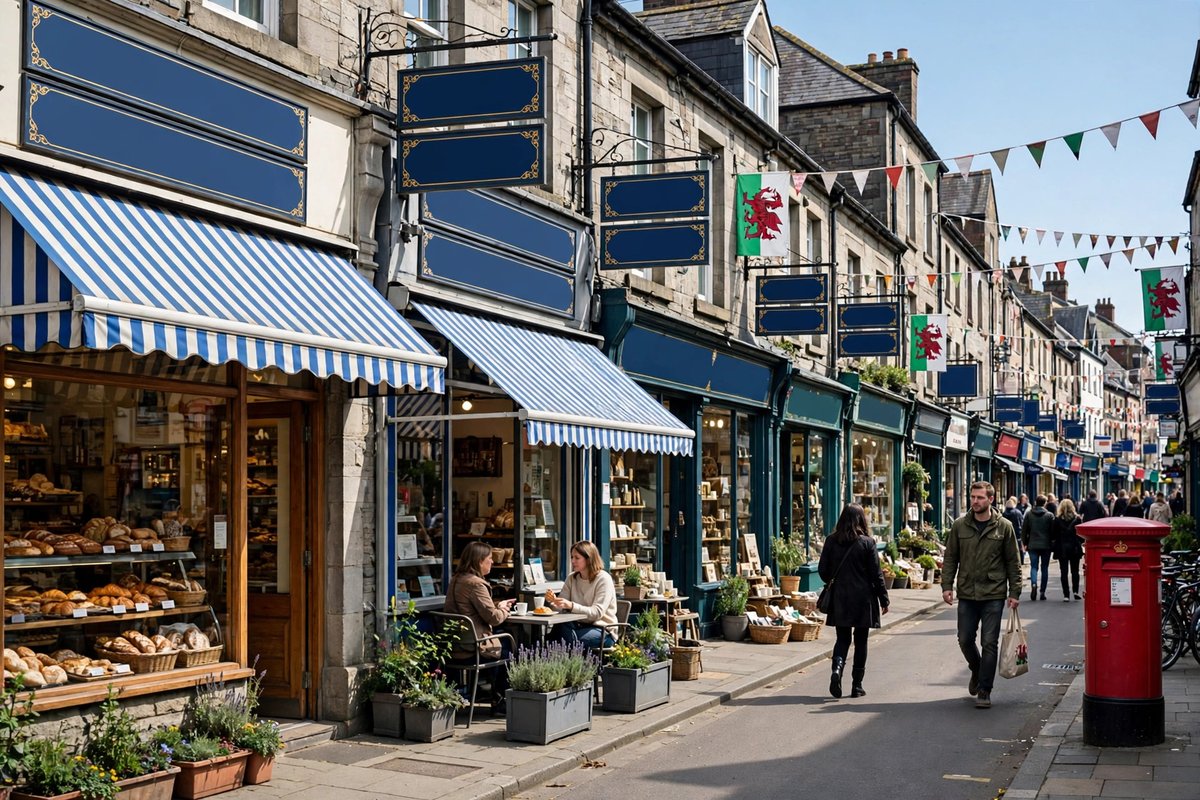
Wales is a small country with proud, separate towns. People search the way they live. A customer in Swansea types "Swansea". A customer in Newport types "Newport". Almost nobody types "Wales" when they need a tradesperson today. That is the first thing to understand about SEO in Wales: the country is the brand, but the town is the search.
Cardiff is the hard one. It is the capital, it has the most businesses, and it has agencies that have worked there for a very long time. One Cardiff guide points out that Liberty Marketing has worked from the city since 2008 and Pinnacle Internet Marketing has run search from Cardiff since 2006. A brand-new page called "SEO Cardiff" does not beat that in a month. It may not beat it in a year. That is not a reason to give up. It is a reason to be clever about where you start.
Swansea is a different shape. It is a big coastal city with its own university, high street and trades, but fewer national agencies fight over it. A good Swansea page, with real local detail, can win faster than the same effort in Cardiff.
Newport sits between Cardiff and Bristol, with commuters and new housing. People there search with Newport in mind, and they notice when a page actually knows Newport instead of pasting "Newport" into a Cardiff page.
Bridgend and the Valleys towns are the quiet opportunity. The searches are smaller, but so is the competition. In many Valleys towns, the top results for a trade are a Facebook page, a directory listing and one rival with a decent website. A business that does the basics properly can own its town's searches in a way that would take years in Cardiff.
My view, true for Wales in a way it is not true for a big English city: win your own town first, then the next town, and let Cardiff come last. A page that knows the streets and the questions people ask at the counter reads like a neighbour. A page that only says "Wales" reads like an outsider guessing.
Your Google Business Profile: the free tool that wins the map
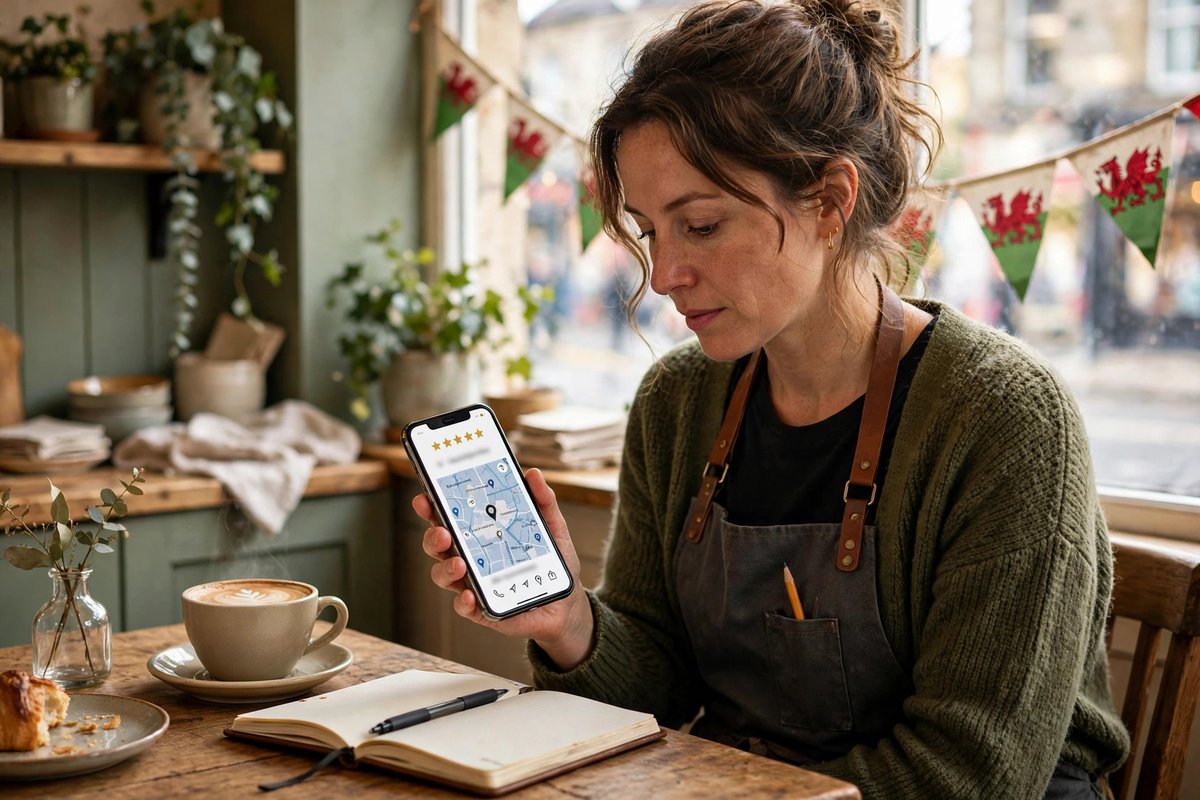
If you do one thing this week, do this. Open your Google Business Profile and check it line by line, the way a customer would.
Is the name exactly the name on your shop sign? Are the hours true, including bank holidays? Are your services listed one by one, in the words customers use? Are there photos of your real shop, your real team and your real work, taken in daylight? Most Welsh small-business profiles fail at least two of those checks, and each small error costs a call.
Then comes the habit that separates the busy firms from the quiet ones. Every week, add one fresh photo. Every week, answer one customer question on the profile. Every month, check one page of your website for old details: a changed dish, a changed price, a changed hour. The power is in the steady habit. Google notices a living profile. Customers notice it too.
Reviews deserve the same care. Ask at the end of a good job, make it one tap, and reply to each one by name. In most Welsh towns, the business with the freshest genuine reviews takes the call.
Welsh and English: the bilingual search habit most agencies miss
Want this for your business?
SEORankGulf ranks your business on Google's first page — with local SEO, technical fixes, and content that brings customers.
Get a free SEO auditHere is something no agency outside Wales handles well, and most agencies inside Wales never mention. Wales has two languages, and people search in both.
Most searches are in English. That is where the volume is. But Welsh-language search is real, and it matters in two places. First, Welsh-speaking customers in the north and west, and in Welsh-speaking communities everywhere, sometimes search in Welsh for local services. Second, public bodies and organisations that must follow Welsh Language Standards need content written by Welsh speakers, not translated by a machine.
Translated keyword lists produce terms nobody searches. That is a direct warning from a Cardiff agency guide, and it is worth taking seriously. If you serve Welsh-speaking customers, your Welsh pages need a Welsh speaker behind them, not a translation tool.
For most small businesses, the smart move is simple: keep your main pages in clear English, then add one honest Welsh page for your main service, written by a Welsh speaker, if you serve a Welsh-speaking area. The volume will be small and the competition close to zero.
A Cardiff café story: one owner's Monday-morning routine
Meet Lowri. She runs a small independent café on Wellfield Road in Roath, Cardiff, a short walk from the city centre, with regulars who come for the same table and coffee. Her weekends are busy. Her weekday mornings are quiet. The problem is simple: people searching nearby at breakfast time find the chains first, not her.
Lowri has twenty minutes every Monday morning, before the first customer arrives. Here is what she does with them — a routine any Welsh owner can copy.
First, she opens her Google Business Profile on her phone. She checks the hours are right for the week ahead, reads any new review, and replies to it by name. If a customer asked a question on the profile, she answers it there, so the next person with the same question sees the answer before they call.
Second, she adds one photo. Not a stock photo. A real one: the counter in the morning light, a new cake, the table by the window. One photo a week is fifty-two photos a year, and a profile with fresh photos looks open in a way a profile with three old photos never does.
Third, she checks one search. She types "café Roath" or "breakfast near Roath Park" into Google and looks at who appears. If a rival appears above her, she opens the rival's page and asks one question: what does it say that mine does not? Usually the answer is simple, and she adds the missing piece to her own page that week.
Fourth, she writes down one question a customer asked her that week. "Do you do gluten-free cake?" "Can I book the back table for six?" Each question becomes a short answer on her website or her profile. Over a year, those answers become the most useful pages on her site, because they answer the exact words real customers use.
None of this is clever. All of it works. Lowri is not trying to beat every café in Cardiff. She is trying to be the obvious choice for someone standing in Roath, hungry, with a phone in their hand. That is a smaller fight, and it is one she can win.
This story is not a promise. It is a method you can copy. Swap the café for your trade, Roath for your patch, and the counter questions for the ones your customers ask you.
How to do the first month yourself
You do not need to hire anyone to start. You need a plan, a few evenings, and the discipline to finish one small job at a time. Here is a first month any owner can follow.
Week one is the audit. Walk through your website the way a customer would. Click every link. Read every page out loud. Fix the broken links, the wrong phone number, the old hours. Check your Google Business Profile line by line, as described above. Write down the three searches that matter most to your business — your main service plus your town, in the exact words a customer would type.
Week two is the pages. Write or rewrite one page for your main service in your home town. It should answer, in full: what you do, how long it takes, how the price works, what the customer should bring or prepare, and how to book. Keep the sentences short. Use the words your customers use, not trade jargon. Add your phone number where the eye lands first, not buried at the bottom.
Week three is the proof. Ask three happy customers for a review, at the end of a good job, face to face. Add real photos of your work, your team and your place. Check that your business name, address and phone number match exactly on your website, your profile, and the main directories.
Week four is the habit. Set the Monday routine: one photo, one review reply, one question answered, one search checked. Write down what you will do next month: the second town page, or the second service page, or a short guide that answers your most common question. Then do it. By month four or five, you should feel the difference: the phone rings with better questions, and fewer people ask "Do you do this?" because your pages already answered it.
Here is a question worth following up: what does a full local plan look like in practice, from business profile to town pages? Our SEO services in New Zealand guide walks through the same town-by-town method in another small market, and it will help you spot the gaps in your own site faster.
How to judge an SEO company in Wales
Sooner or later, most owners think about hiring help. The question is how to pick well. Start with proof, not promises. Ask for examples of work for firms like yours. Not screenshots with names cut out. Real pages you can open. Real search phrases you can test yourself. Look at how those pages read. Do they answer a real question? Do they sound like a person wrote them? If the example pages read like they were written only for Google, your own pages will read that way too.
Next, ask who will do the work. Some firms sell well and then hand your account to someone new each month. Ask for the name of the person who will work on your site. Ask how often you will hear from them. A short monthly note in plain words beats a long report you never read. That note should say what was done, what changed, and what comes next. It should also say what did not work.
Check the contract with care. Look at the length of the tie-in, the notice period, and what happens to your content if you leave. Your website content, your business profile and your domain name should stay yours. Ask what is inside the monthly price, in writing. Vague lines like "full SEO" leave room for surprise charges later.
Ask how success will be measured. Rankings alone are weak. A page can rank well and still bring no calls if the phone number is hard to find. Good measures are calls, form fills, bookings and direction requests, tracked from day one.
Watch for the warning signs. A promise of a top spot in days is the loudest one. No honest firm can promise that, because Google decides rankings and Google changes its mind often. A firm that will not show its work, or sends a long report full of jargon but never says what it did, is another. A firm that asks you to pay for many links but cannot name a single site that will link to you is a third. A firm that copies text across clients, or spins old articles into "new" ones, puts your site at risk. And watch for pressure: "Sign today or the price doubles" is not a sales technique, it is a warning. Real firms do not need false urgency.
One more check matters, and it is specific to Wales. Ask the firm what it knows about Welsh search. Can it name the towns it has ranked clients in? Has it ever written a Welsh-language page? Does it understand that Cardiff, Swansea, Newport and the Valleys search differently? A firm that talks about Wales as one place, with one page and one price, has not done the work. A good guide to Cardiff agencies makes the same point from the other side: the firms that win in Wales are the ones that know its towns, its language rules and its local habits.
What about AI search: ChatGPT and Google AI Overviews in Wales?
Search is changing, and Welsh owners should know how. When someone asks ChatGPT or Google's AI Overview a question like "how much does SEO cost in Wales", the answer is built from pages the AI can read, trust and quote. Pages with clear answers, real numbers, named places and honest detail get cited. Pages full of vague claims do not.
There is a useful sign of this on the very first page of results for "seo wales" today. Google shows an AI Overview for this search, citing Welsh SEO sites. That means the AI answer is already shaping what searchers see before they ever click a link.
Here is a second fact that shows why this matters. IT Jobs Watch reports that the median salary for an SEO Engineer in Wales is £53,171 a year, based on vacancies in the six months to 5 November 2026. Only three such jobs were advertised in that period, yet the pay is above the UK median of £48,115. Welsh businesses are paying more than the UK average for SEO skill, because the skill is scarce here.
The practical advice is simple. Write pages that answer one question completely, in plain words, with real detail. Use short paragraphs, headings that match the question, and the answer near the top. Keep your business details true and consistent everywhere.
Frequently asked questions
How much does SEO cost in Wales?
Published UK agency prices for Wales start around £299 a month, with many firms charging £400 to £700, and the average UK monthly retainer is around £1,000. SEORankGulf plans are $300, $600 and $1,200 a month. Compare the written task list inside the price, not just the number.
How long does SEO take in Wales?
Most local businesses see movement within 6 to 12 weeks, with stronger results over 3 to 6 months, depending on competition. Cardiff terms take longer because established agencies have worked there for years, while a quiet Valleys town can move faster. Watch for steady monthly progress in calls and enquiries.
Do I need a Cardiff-based agency, or can a remote team rank my business?
A remote team can rank a Welsh business locally, because the work happens on your website, your profile and your listings, not in an office. What matters is proof that the team has ranked businesses like yours, and whether it understands Welsh towns and Welsh-language search. Ask for local examples before you decide.
Should my website have Welsh-language pages?
If you serve Welsh-speaking customers, yes — one honest Welsh page for your main service, written by a Welsh speaker, builds trust that an English-only site cannot. The search volume is small, but the competition is close to zero. Clear English pages come first; a Welsh page follows where it matters most.
What is the most important first step for SEO in Wales?
Your Google Business Profile. Claim it, complete it, load real photos, list your services and start gathering reviews. For most Welsh small businesses it is the highest-value hour of marketing work available, and it is free.
Your next step
Start with the truth. A proper audit shows where your business appears today — town by town, search by search — and what the businesses beating you have actually done.
Our audit is free. Message us on WhatsApp at +92 315 0642491 or call now to claim your free SEO audit. You will get a plain-English report and an honest plan, sized to a Welsh small business — including if the honest advice is to fix three things yourself and spend nothing this year.
Then, when you are ready to compare what good SEO work looks like month by month, read our SEO services page next. It lays out the work in order, so you can judge any provider — including us — against the same plain list.